
“There is a great difference between simply living a long life and living a full and rewarding life. What’s really important is how much rich texture and color we can add to our lives…” -Daisaku Ikeda
“There is a great difference between simply living a long life and living a full and rewarding life. What’s really important is how much rich texture and color we can add to our lives…” -Daisaku Ikeda
I began my service in the social work field in 1973, received my MSW in 1977, and obtained my clinical license (LCSW) in 1979. My graduate training focused on medical social work, and I have been employed in child welfare, hospital, clinic, and rehabilitation services. I opened my private practice in 1986 in Sacramento, California, moving to Ashland, Oregon in 2005, where I obtained my Oregon license in 2006.
When I started my formal Sandtray training, I was a relationally based psychotherapist rooted in child development and object relations theories and well-grounded in systems theory. I also studied the reciprocal relationship between physical anatomy and the development of the self. Later, I studied interpersonal neurobiology. Nearly fifty years ago, I became a practitioner of Nichiren Daishonin’s Buddhism (sgi-usa.org). This philosophy, with its emphasis on the oneness of the universe with body, intellect, emotion, and spirit, informed my professional learning. These approaches are the basis for my Expressive Arts and Sandtray studies and my clinical practice.
In the 1970s, I was introduced to Sandplay by a Jungian analyst. As a young social worker, I became attracted to this approach as a unique way to treat the abused children who were my clients. I immediately began studying Sandplay techniques in depth, learning about Margaret Lowenfeld’s play therapy methods in the 1980s. I became inspired by her work and intrigued by the ability of her Sandtray methods to aid people of all ages, cultures, and life experiences.
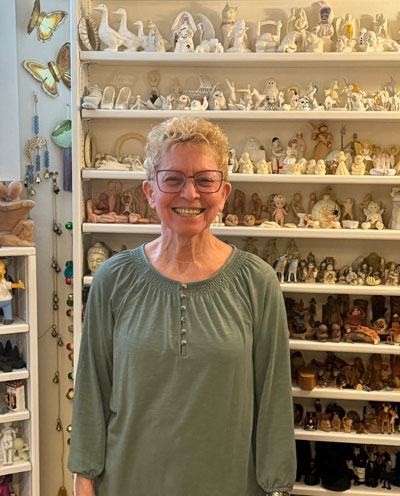
My Sandtray training advanced significantly in 1989 when I began study with Gisela Schubach De Domenico, (Ph.D.). I completed all her experiential and clinical trainings and then advanced to her teacher training during my 11 years of study with her. Eventually I became a trainer for her “Level 1 and 2” courses. As my own teaching progressed, I began to find innovative ways to respond to workshop participants’ questions. A natural outcome of my continued growth was to develop my own way of instruction in the use of Sandtray.
The most significant influence on me as a psychotherapist was my relationship with my professional mentor. In 1973 I met Betty Russell (LCSW, BCD) and she generously mentored me until her death in 2018. As Betty supported my development she always challenged me to grow.
Retired from psychotherapy, I now offer Sandtray sessions for personal growth and professional consultation. The successful methods that I use are detailed in my book, Sandtray: Playing to Heal, Recover, and Grow.
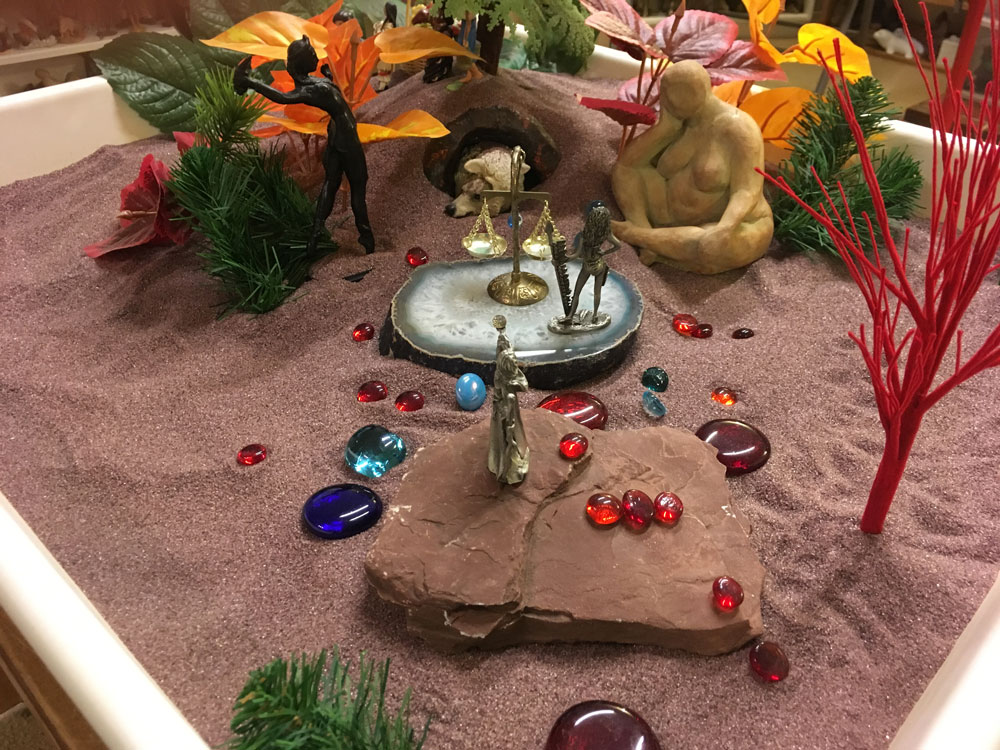
The Sandtray process I promote is rooted in the work of play-research pioneer Margaret Lowenfeld. She theorized that the physical sensations, emotions, memories, and thoughts are interwoven in young children’s minds, identifying our preverbal understanding. Lowenfeld called this form of thought “Picture Thinking.” She developed the Sandtray tools which allowed children to express themselves in an intensely personal, visual, and kinesthetic manner which circumvented the use of words. Her method became known as “Lowenfeld’s World Technique.” Her technique has been adopted by other theorists and used with people of all ages and in many cultures.
Lowenfeld’s approach resonates with me as the practitioner does not interpret or analyze the sand world. Instead, I function as a Witness or a guide to enrich the Creator’s focus, so that they can explore and harvest wisdom from the lesser-known parts of themselves. Sometimes our experiences are beyond words, and at other times our words cannot accurately reflect our experiences. The sand tray Creator makes their own discoveries. Control lies with the maker of the world, and with a practitioner’s aid, fresh personal perceptions and meanings may unfold. This Sandtray process can be a deeply intimate time with oneself that clarifies what actions we need to take to heal, recover, and grow.